
The news of the full-scale Russian invasion of Ukraine broke out in the early hours of 24 February 2022, immediately disrupting energy markets, but the energy crisis had begun much earlier, in 2021, as the global gas market faced combined pressures from the wake of Covid-19, Asian demand, and an unusually strong preceding winter that left European storage depleted.
It wasn’t until supply on Nord Stream 1 was progressively cut from June 2022, however, that Europe was forced into the global LNG market at the moment it needed to fill storage for the following winter, and the crisis intensified. TTF (the European gas price benchmark) reached €300/MWh in August 2022 against pre-crisis norms of €15–25/MWh, more than ten times its normal level. The UK’s own benchmark (NBP) monthly average peaked at the same time. Two months later, UK CPI peaked at 11.1%.
Yet low-carbon technologies generated over half of Britain’s electricity that year, leaving people puzzled as to why the country seemed so exposed to fluctuating gas prices. For the first time, the way electricity prices are set became a matter of everyday conversation. The Department for Business, Energy and Industrial Strategy had already committed to launch the Review of Electricity Market Arrangements on 18 July 2022.
The marginal pricing system
During this time, and in response to increasing public backlash over rising bills, Octopus Energy’s chief executive, Greg Jackson, explained why the UK was not benefiting from its cheaper renewable generation. The culprit, he said, was the way the electricity market sets a single price, a system he called “bonkers” and “outdated”.
This works as follows: wholesale electricity prices clear through a formal auction at the cost of the last unit needed, and most of the time that last unit burns gas, so low-cost generators, such as wind, solar and nuclear, are paid a gas-set price regardless of what they cost to run.
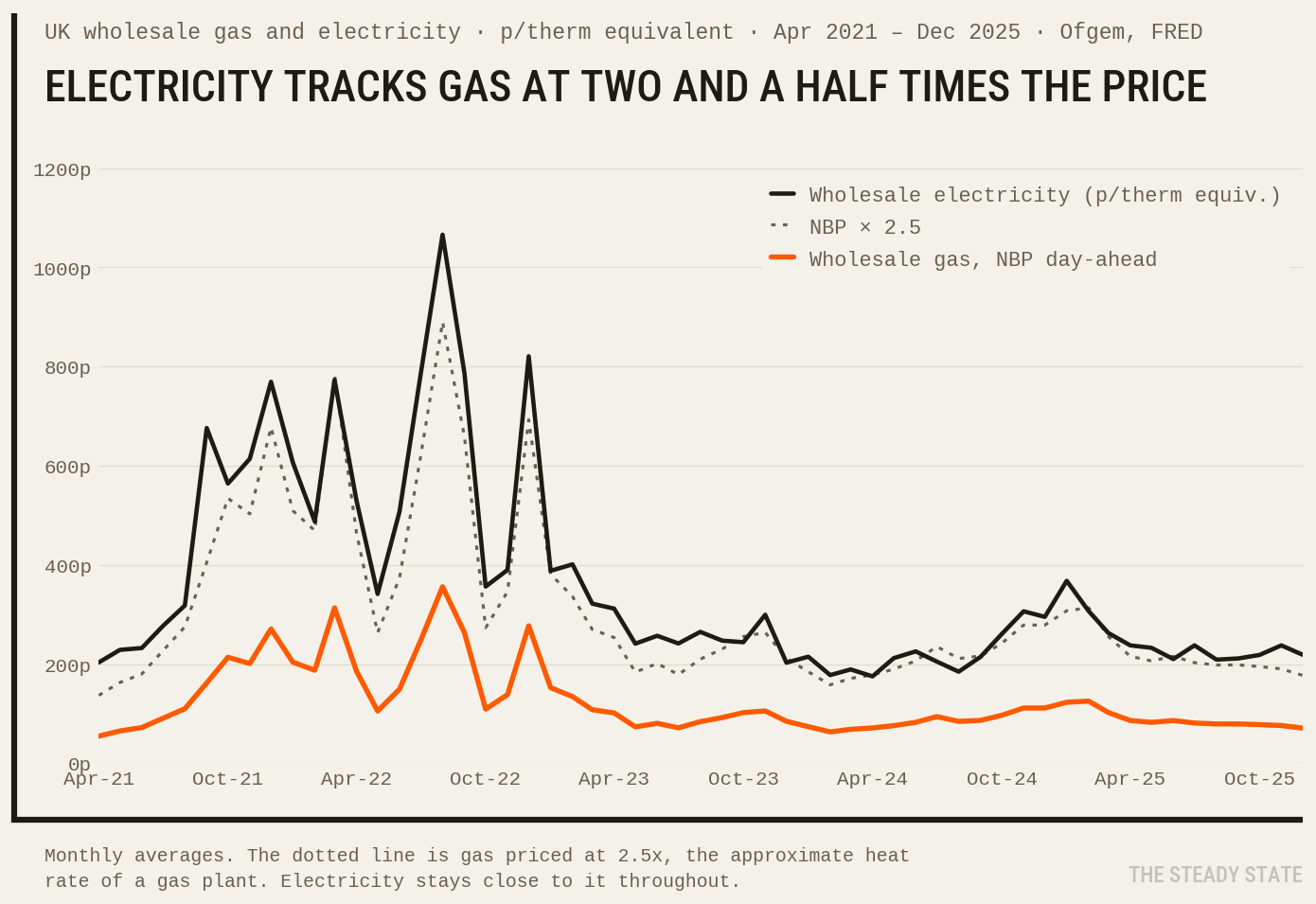
The electricity marginal pricing system, introduced by Thatcher in 1990, is now well understood, but what is less discussed is that, despite the lack of a formal auction process, the same logic operates in the gas market. Liquefied Natural Gas (LNG) shipped in boats from across the globe is frequently and increasingly the UK’s marginal supply, so NBP has to increase to attract that last unit of LNG required to meet domestic demand, while domestic gas producers or pipeline gas importers whose costs typically sit far below LNG receive the LNG-set price on every unit. The greater the gas import dependency, the greater producers' returns, as an ever-increasing amount of LNG at higher prices is required to offset domestic shortfalls. The result is that around the time of Jackson’s intervention, gas producers, both domestic and abroad, as well as domestic electricity generators, received enormous windfalls, distributed unequally between producers, importers and electricity generators.
The exposure to gas prices has been known for a long time, but while gas prices were low, little was done about it. In 2014, the government introduced Contracts for Difference (CfDs), a contract that stabilised prices paid for electricity generation, with the Low Carbon Contracts Company, a government-owned body, as the counterparty, and the balance ultimately transferred to the public via the price cap. This stabilised prices for contract holders, but the policy was aimed primarily at reducing the risk faced by renewable energy investors, who needed greater pricing certainty in the early years of investment, rather than as a price stability policy. Contracted output returned over £1bn between April 2022 and March 2023 to consumers, arriving in the price cap as a negative number.
Renewable Obligation (RO) generators, by contrast, receive a premium on top of the marginal gas-set price. The RO closed to new accreditation in 2017, but existing contracts remain in place until 2037, and this still covers a substantial share of low-carbon generation. However, those returns, like the rest of the marginal pricing system, are set primarily by LNG.
The government’s response
The overall impact of the energy price shock on inflation caught the government off-guard. The OBR had to amend their models (1, 2) after capturing only half of the shock's cost-push effect. The government addressed the growing outrage with two taxes. The Energy Profits Levy (EPL) took a share of what North Sea producers earned above their costs, while the Electricity Generator Levy (EGL) took a share of what non-gas generators earned above a set price. By January 2023, North Sea producers faced an additional tax rate of 35% of profits while non-gas generators faced 45%.
The introduction of these taxes was justified on the basis that they would fund a subsidy called the Energy Price Guarantee (EPG), which limited a typical household’s annual bill to £2,500, and thus was framed as a direct transfer to the public. But this justification has since lapsed. The Energy Price Guarantee ceased to be binding on 1 July 2023, when the Ofgem cap fell below it, and formally ended on 31 March 2024. Even before the war in Iran reignited the energy crisis, the Energy Profits Levy was set to run to March 2030 and was being replaced by a permanent oil and gas price mechanism, while the Electricity Generator Levy rose to 55% in July 2026. Overall, EPG costs outweighed income from the levies by a large margin. While the taxes are redistributive, the policy leaves the underlying pricing mechanisms intact, simply changing who gets to extract the windfalls, while the relief offered against the prices households face is watered down.
Fearful of what the levy-and-subsidy imbalance might mean for its fiscal rules, the Labour government has already announced that any support in this crisis will be more limited than the broad support previously offered by the EPG.
For its part, the Bank of England admitted early on that the energy price shock was beyond its reach as the monetary authority, but watched diligently for any sign of wage increases. Not as a sign real incomes were being protected, but as the sign of second-round effects that had to be stopped. Bank Rate was eventually raised from 0.1% in December 2021 to 5.25% in August 2023. But despite the acknowledged limitations, the Bank did not advise revising market structures to support its inflation target, nor did it advise deploying fiscal policy to similar effect.
The levies and the EPG were the most direct interventions in inflation that the fiscal authority had undertaken since the 1980s. They were, nevertheless, a palliative response, and it remained one even as analysts and MPs continued to critique the marginal pricing system, pointed out that a country short of energy was exporting gas at record rates, and noted that decades of underinvestment had left us with limited gas storage capacity.
An unexpected event gives a glimpse of the alternative
